About the Journal
Inquiries in Applied Empirical Sciences publishes research where theoretical models and practical interventions are tested directly against observational, experimental, or field data. Rather than separating disciplines by subject matter, the journal unites researchers across engineering, environmental science, biomedicine, and the quantitative social sciences who share a common methodological commitment: claims must be anchored in measurable evidence, verifiable statistical inference, and reproducible workflows.
Aims and Scope Across many applied disciplines, a persistent gap remains between mathematical or conceptual modeling and real-world performance. Inquiries in Applied Empirical Sciences addresses this divide by focusing on how empirical designs—ranging from controlled laboratory trials and sensor-based field monitoring to quasi-experiments and large-scale longitudinal datasets—validate, refine, or refute applied theories.
We actively seek manuscripts that confront the messy realities of applied data: measurement error, confounding variables in natural settings, scale-up failures, and cross-domain transferability. Purely theoretical derivations, uncalibrated simulations, or black-box computational models evaluated solely on synthetic benchmarks fall outside our scope. Conversely, the journal strongly encourages well-powered replication studies, methodological critiques of established measurement tools, and technically sound investigations reporting null results that correct the publication record.
Current Issue
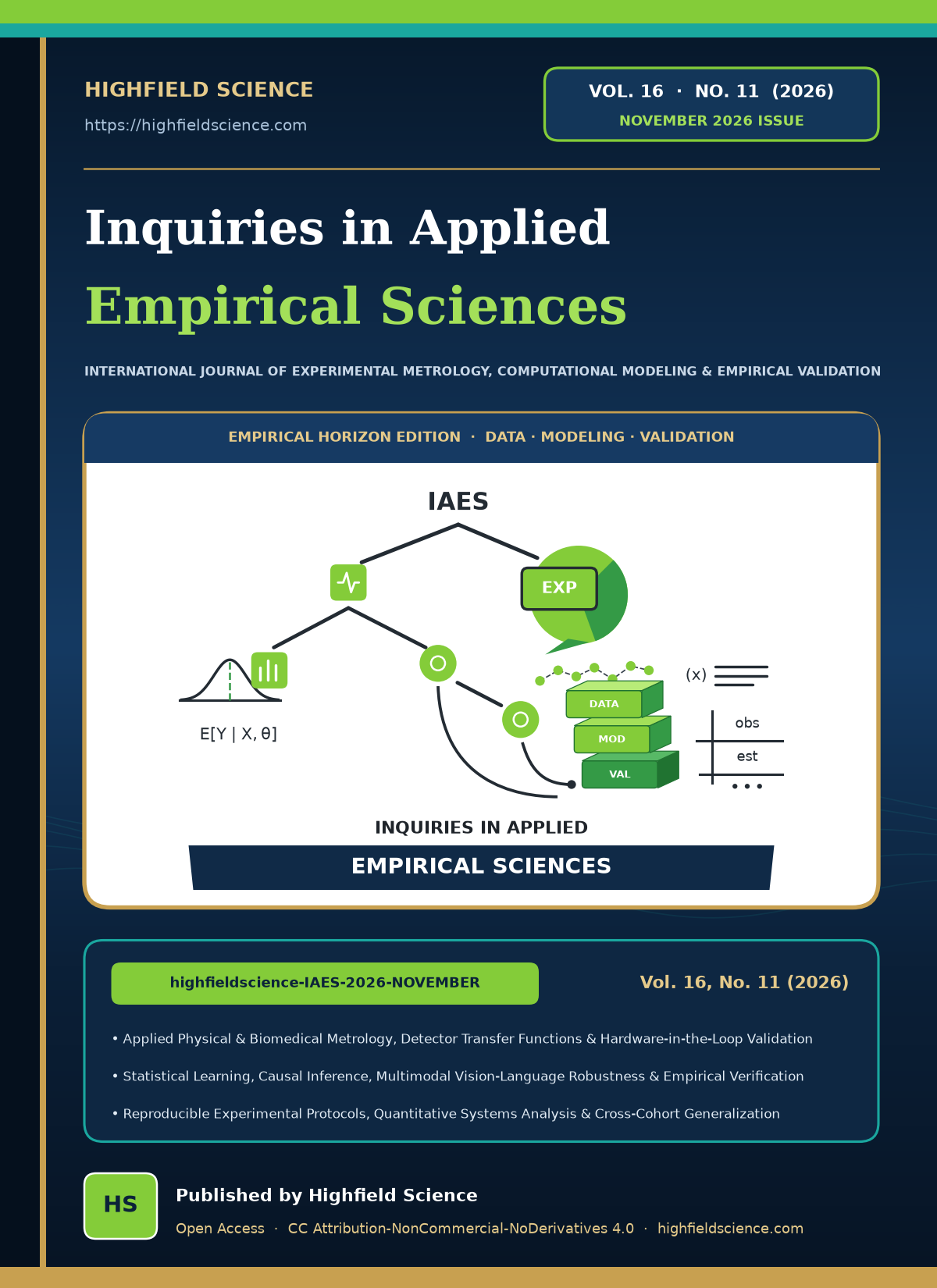
Advancing Rigorous Empirical Inquiry & Methodological Transparency
Dedicated to publishing high-impact quantitative, experimental, and observational research across the applied and foundational sciences. Every submission undergoes structured editorial vetting and independent peer evaluation focused on analytical soundness and reproducibility.
Core Publication Tracks
Scope & CoverageOriginal Empirical Studies
Full-length experimental, field-based, clinical, and quantitative investigations presenting primary datasets, formal statistical modeling, and reproducible conclusions.
Methodological & Technical Advances
Focused articles introducing novel instrumentation, computational pipelines, measurement frameworks, or validated analytical algorithms with direct research utility.
Systematic Reviews & Meta-Analyses
Rigorously structured evaluations of existing literature utilizing formal inclusion criteria and quantitative synthesis to resolve complex empirical questions.
Replication & Boundary Studies
Independent reproductions, robustness checks, and empirical stress-tests of foundational studies that strengthen cumulative scientific reliability.
Editorial Evaluation Pipeline
Quality AssuranceInitial assessment of methodological completeness, ethical compliance, and originality prior to external assignment.
Evaluation by domain specialists examining experimental design, statistical validity, and evidentiary claims.
Structured revision verification ensuring all technical critiques and data reporting standards are fully addressed.
Professional typesetting, metadata registration, and immediate open-access release with permanent archival preservation.
All submissions are screened for originality and evaluated in accordance with international publication ethics standards regarding authorship attribution, conflict-of-interest disclosure, human and animal welfare oversight, and data availability. Published works are permanently indexed and preserved for unrestricted scholarly citation.